
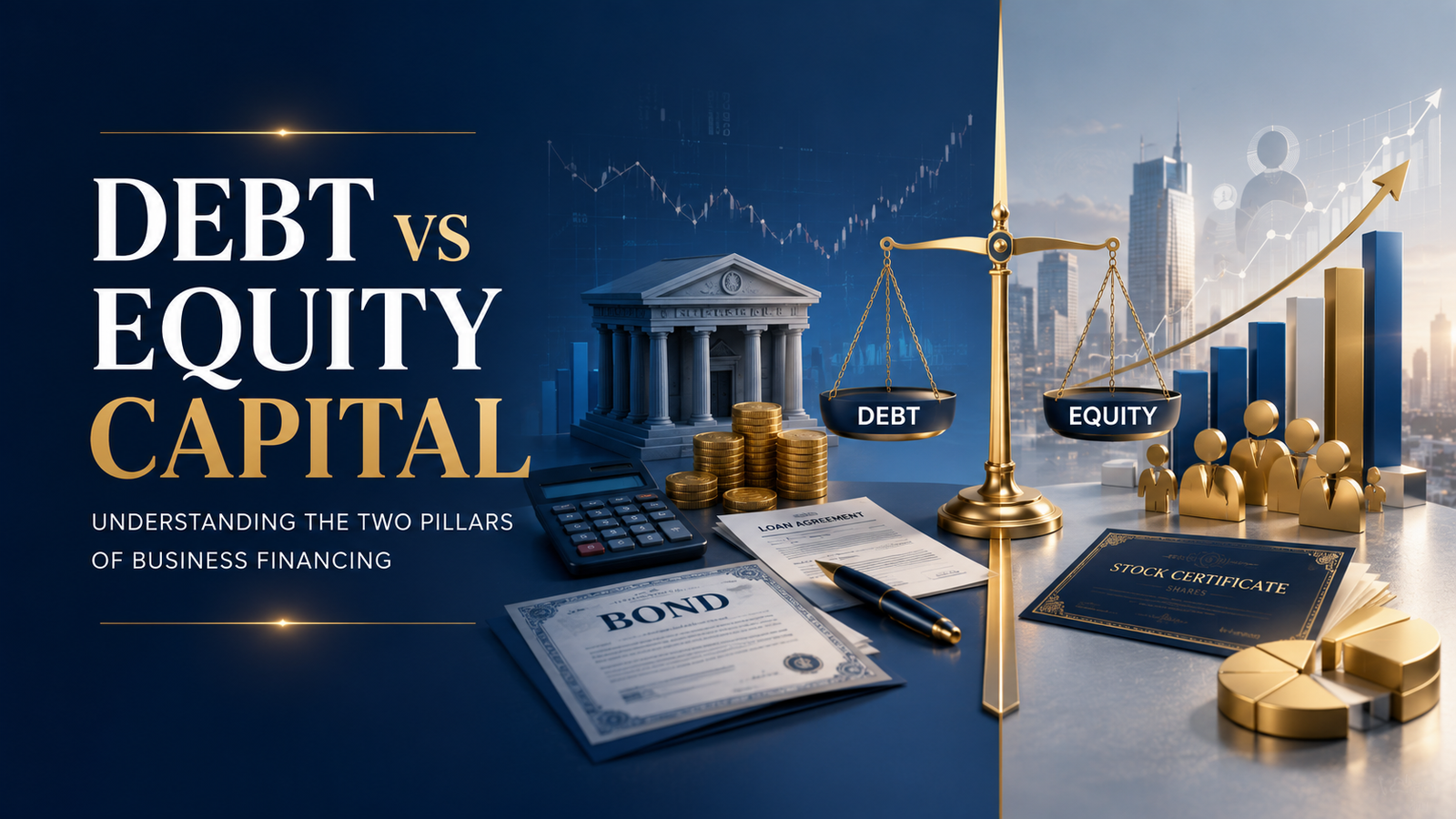
When a business needs money — whether to launch, expand, purchase equipment, or simply keep operations running smoothly — it essentially has two broad options: borrow it or raise it from owners. These two paths are known as debt capital and equity capital, and the choice between them shapes nearly every aspect of a company’s financial future, from risk exposure to control over decision-making.
This article breaks down both forms of financing in depth, comparing their advantages, drawbacks, and the situations where one tends to make more sense than the other.
What Is Debt Capital?
Debt capital refers to funds a business borrows from external sources with the obligation to repay the principal amount, usually along with interest, over an agreed period. Common sources of debt capital include:
- Bank loans
- Corporate bonds
- Lines of credit
- Equipment financing
- Trade credit from suppliers
- Debentures
Debt is a contractual obligation. Regardless of how well or poorly the business performs, the borrower is required to make scheduled payments. Failure to do so can result in penalties, damaged credit standing, or in severe cases, legal action and forced liquidation of assets.
What Is Equity Capital?
Equity capital, on the other hand, represents money raised by selling ownership stakes in the company. Instead of promising repayment, a business offers investors a share of ownership, which typically comes with a claim on profits (often through dividends) and, in many cases, voting rights on major corporate decisions.
Common sources of equity capital include:
- Funds contributed by founders
- Angel investors
- Venture capital firms
- Private equity investors
- Public stock offerings
- Retained earnings reinvested into the business
Unlike debt, equity capital does not require fixed repayments. Investors are compensated through capital appreciation (the value of their shares increasing over time) and, in some cases, dividend payments, but there is no guarantee of either.
Core Differences Between Debt and Equity Capital
1. Repayment Obligation
Debt must be repaid according to a fixed schedule, regardless of business performance. Equity carries no repayment obligation — if the business does poorly, shareholders simply see the value of their investment decline; there is no contractual right to demand their money back (except in specific circumstances like liquidation).
2. Cost of Capital
Interest paid on debt is generally tax-deductible in most jurisdictions, which lowers its effective cost. Equity, while it doesn’t involve fixed payments, is often considered more expensive in the long run because investors demand higher returns to compensate for the additional risk they are taking by not having a guaranteed repayment.
3. Ownership and Control
Taking on debt does not dilute ownership — a business owner who borrows money from a bank retains full control over decision-making (subject to any covenants the lender may impose). Raising equity capital, by contrast, means giving up a portion of ownership and often some degree of control, especially when investors negotiate board seats or veto rights over major decisions.
4. Risk Profile
From the company’s perspective, debt increases financial risk because payments are mandatory. From the investor’s perspective, however, debt is less risky than equity because lenders are paid before shareholders in the event of liquidation. Equity investors bear more risk since they are last in line to be paid, but they also stand to gain the most if the company performs exceptionally well.
5. Impact on Financial Statements
Debt appears as a liability on the balance sheet and requires interest expense on the income statement. Equity appears as shareholders’ equity and does not create a recurring expense line, though issuing new equity can dilute earnings per share for existing shareholders.
Advantages of Debt Capital
- Retains full ownership — owners do not have to share control or profits with new investors.
- Tax benefits — interest payments often reduce taxable income.
- Predictable cost — the cost of debt (interest rate) is usually fixed or predictable, making it easier to plan around.
- Can amplify returns — if a business can generate returns higher than the cost of borrowing, using debt (leverage) can boost overall returns for existing owners.
Disadvantages of Debt Capital
- Mandatory repayment — regardless of business performance, payments must be made, which can strain cash flow during slow periods.
- Collateral requirements — many loans require the business to pledge assets as security, which are at risk if the company defaults.
- Covenants and restrictions — lenders often impose conditions on borrowers, such as maintaining certain financial ratios, which can limit operational flexibility.
- Increases financial risk — high debt levels can make a company more vulnerable during economic downturns.
Advantages of Equity Capital
- No repayment pressure — there are no mandatory principal or interest payments, which reduces cash flow strain.
- Shared risk — investors share in the losses if the business underperforms, rather than the company alone bearing that burden.
- Access to expertise and networks — particularly with venture capital or angel investors, equity financing often comes with valuable mentorship, industry connections, and strategic guidance.
- Improves borrowing capacity — a stronger equity base can make it easier to secure debt financing later, since lenders view a well-capitalized business as less risky.
Disadvantages of Equity Capital
- Dilution of ownership — founders and existing shareholders own a smaller percentage of the company after new equity is issued.
- Loss of control — investors may demand board representation, voting rights, or veto power over key decisions.
- Higher long-term cost — successful companies may end up paying more in the long run through dividends and capital appreciation than they would have paid in interest on debt.
- Time-consuming process — raising equity capital, especially from institutional investors, often involves lengthy due diligence, negotiations, and legal work.
When Does Debt Make More Sense?
Debt financing tends to be more appropriate when:
- The business has predictable, stable cash flow that can comfortably cover interest and principal payments.
- The company wants to preserve ownership and avoid diluting control.
- Interest rates are relatively low, making borrowing cost-effective.
- The funds are being used for a specific, income-generating purpose, such as purchasing equipment that will directly increase revenue.
- The business already has a healthy balance sheet with manageable existing debt levels.
When Does Equity Make More Sense?
Equity financing tends to be more suitable when:
- The business is in an early or high-growth stage with uncertain or volatile cash flow.
- The company needs a significant amount of capital that would be difficult to service through debt repayments.
- Founders are willing to share ownership in exchange for reduced financial risk and potential strategic support from investors.
- The business operates in a capital-intensive industry where heavy debt could be dangerous if projections don’t pan out.
- There is a desire to strengthen the balance sheet to make the company more attractive for future debt financing.
The Role of a Balanced Capital Mix
In practice, most companies do not rely exclusively on either debt or equity. Instead, they use a blended approach, adjusting the ratio over time based on their financial position, growth stage, and market conditions. This blend is often referred to as the company’s capital structure, and finding the right balance is one of the most critical financial decisions a business will make.
A company that leans too heavily on debt risks financial distress during downturns, while one that relies too much on equity may grow too slowly or give away too much ownership and control. The most financially resilient companies tend to strike a balance that allows them to benefit from the tax advantages and control preservation of debt, while maintaining enough equity cushion to absorb shocks and pursue long-term strategic goals.
Key Metrics to Evaluate the Debt-Equity Balance
- Debt-to-Equity Ratio — shows the proportion of debt relative to shareholder equity; a higher number indicates heavier reliance on borrowed funds.
- Interest Coverage Ratio — measures a company’s ability to meet interest obligations from its operating income.
- Return on Equity (ROE) — indicates how effectively a company is using shareholder capital to generate profit, which can be influenced significantly by how much leverage (debt) is used.
- Cost of Capital — a blended measure that reflects the overall cost of financing a company through both debt and equity sources.
Hybrid Instruments: Blurring the Line Between Debt and Equity
While debt and equity are often presented as two clearly separate categories, in practice, businesses frequently use hybrid instruments that combine features of both.
Convertible Debt — this starts as a loan but includes a provision allowing the lender to convert the outstanding debt into equity shares under specific conditions, often used by early-stage companies as a way to delay agreeing on a formal company valuation while still securing needed funding.
Preferred Equity — although technically equity, preferred shares often behave more like debt, offering fixed dividend payments and priority over common shareholders, without the voting rights typically associated with ownership.
Mezzanine Financing — this is a blended form of financing that typically ranks below traditional debt but above equity in terms of repayment priority, often used to fund expansion or acquisitions when a company has exhausted more conventional borrowing options but wants to avoid excessive equity dilution.
These hybrid instruments allow companies greater flexibility in structuring their capital in ways that suit their specific risk tolerance, growth stage, and ownership preferences.
Tax Implications of Debt and Equity
Tax treatment is one of the most significant practical differences between debt and equity financing, and it often plays a major role in financing decisions.
Interest payments on debt are typically classified as a business expense, which reduces a company’s taxable income, effectively lowering the real cost of borrowing. This tax advantage is often referred to as a “tax shield,” and it’s one of the primary reasons companies, especially profitable ones facing high tax rates, often lean toward debt financing when possible.
Dividend payments to equity shareholders, on the other hand, are typically paid out of after-tax profits and do not provide a similar tax deduction for the company. In many jurisdictions, dividends may also be taxed again at the shareholder level, creating what is sometimes referred to as double taxation, though the specific tax treatment varies significantly across different countries and business structures.
Impact on Financial Ratios and Investor Perception
The mix of debt and equity a company uses significantly affects several closely watched financial ratios that investors and analysts use to assess business health:
Return on Equity (ROE) tends to increase with higher leverage, since profits are measured against a smaller equity base, though this can create a misleading picture of underlying business performance if not analyzed alongside risk metrics.
Earnings Per Share (EPS) can be affected differently depending on the financing choice — issuing new equity dilutes EPS by increasing the total number of shares outstanding, while using debt financing keeps the share count unchanged, potentially preserving or boosting EPS if the borrowed funds generate returns above the cost of debt.
Credit Ratings are heavily influenced by a company’s debt levels relative to its equity and cash flow. Companies with excessive debt relative to their earnings capacity often receive lower credit ratings, which can increase their future borrowing costs, creating a cycle that makes additional debt financing progressively more expensive.
Practical Scenarios: Choosing Between Debt and Equity
Scenario 1: A mature manufacturing company wants to purchase new equipment. Since the company has predictable cash flow and the equipment itself can serve as collateral, debt financing, such as an equipment loan, is often the more cost-effective and practical choice, preserving ownership while taking advantage of the tax-deductible interest.
Scenario 2: An early-stage technology startup needs funding to scale operations. Given the unpredictable revenue and lack of significant physical assets, equity financing from angel investors or venture capital is typically more appropriate, since it avoids the pressure of fixed repayments that the business may not yet be able to reliably meet.
Scenario 3: A retail business needs to smooth out seasonal cash flow fluctuations. Short-term debt instruments, such as a line of credit, are often well-suited for this purpose, providing flexible access to funds without requiring the business to give up ownership for what is fundamentally a temporary, recurring cash flow need.
Scenario 4: A company wants to fund a large acquisition. Larger transactions often involve a blended approach, using a combination of new debt, existing cash reserves, and sometimes new equity issuance, depending on the size of the deal, the acquiring company’s existing leverage, and prevailing market conditions.
Long-Term Strategic Considerations
Beyond the immediate financial mechanics, business owners should think about how today’s debt-versus-equity decision shapes tomorrow’s options. Taking on significant debt early can limit future borrowing capacity if the business needs additional loans later, since lenders typically evaluate existing obligations before extending new credit. Similarly, giving away substantial equity in early funding rounds can leave founders with a smaller stake by the time the company reaches maturity, even if the business itself becomes highly valuable.
Thinking several steps ahead — considering not just the immediate funding round but the likely sequence of future financing needs — often leads to smarter capital structure decisions than optimizing purely for the current moment.
Conclusion
Debt and equity capital each carry distinct advantages and trade-offs, and the right choice depends heavily on a company’s specific circumstances — its stage of growth, cash flow stability, risk tolerance, and long-term strategic goals. Debt offers the benefit of retained ownership and tax efficiency but comes with the pressure of mandatory repayment. Equity relieves that repayment pressure but requires giving up a share of ownership and, often, some degree of control.
For most businesses, the smartest approach is not choosing one over the other entirely, but thoughtfully blending both to create a capital structure that supports sustainable growth while managing risk appropriately. Understanding these dynamics equips business owners, investors, and finance professionals to make more informed decisions about how a company should be funded at each stage of its development.