
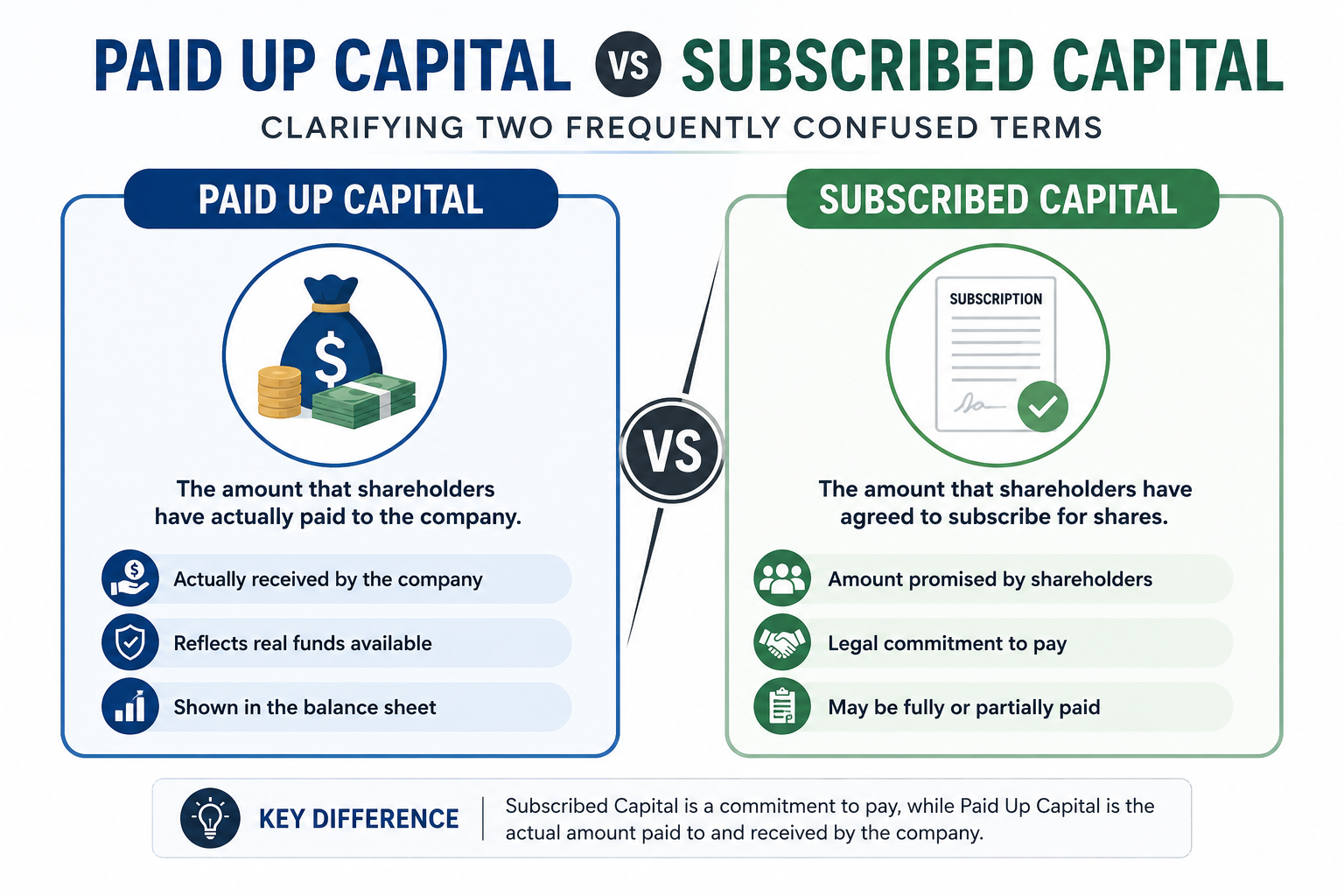
When examining a company’s share capital structure, several closely related terms often appear together, and it is easy for business owners, investors, and even finance students to mix them up. Among the most commonly confused pairs are subscribed capital and paid up capital. While these two terms are closely connected — one usually flows directly into the other — they represent distinct stages in the process of a company raising equity funding.
This article breaks down exactly what each term means, how they relate to one another, and why understanding the difference matters for anyone dealing with company formation, investment analysis, or corporate compliance.
What Is Subscribed Capital?
Subscribed capital refers to the portion of a company’s issued share capital that investors have formally agreed to purchase. When a company decides to raise equity funding, it typically issues shares up to a certain amount (its issued capital), and then offers those shares to potential investors. Subscribed capital represents the amount of those issued shares that investors have committed to buying, whether through a formal subscription agreement, a public offering, or a private placement.
It’s important to understand that being “subscribed” means an investor has agreed to purchase the shares — it does not necessarily mean the investor has already paid the full amount owed. In many cases, particularly with private companies or certain public offerings, investors may agree to pay for their subscribed shares in installments rather than all at once.
What Is Paid Up Capital?
Paid up capital, as the name suggests, refers to the actual amount of money that has been received by the company from shareholders for shares that have been subscribed and issued. It represents real capital that has physically entered the company’s accounts, as opposed to simply being promised or committed.
If an investor has subscribed to shares but has not yet completed full payment, only the portion actually paid counts toward paid up capital, even though the entire subscribed amount is recorded elsewhere in the company’s capital structure documentation.
The Relationship Between Subscribed and Paid Up Capital
To understand how these two concepts connect, it helps to walk through the broader sequence of how share capital moves from a legal ceiling to actual funds in a company’s bank account:
- Authorized Capital — the maximum amount of share capital a company is legally permitted to issue, as set out in its incorporation documents.
- Issued Capital — the portion of authorized capital that the company has actually offered to investors through a formal issuance.
- Subscribed Capital — the portion of issued capital that investors have agreed to purchase.
- Paid Up Capital — the portion of subscribed capital that investors have actually paid for in full.
In many straightforward cases, especially with smaller private companies, subscribed capital and paid up capital are identical, since investors typically pay for their shares in full at the time of subscription. However, in situations involving installment payments, partly paid shares, or certain public offerings, subscribed capital can temporarily exceed paid up capital until investors complete their payment obligations.
Why Companies Allow Partial Payment on Subscribed Shares
It might seem unusual that a company would allow investors to subscribe to shares without requiring immediate full payment, but there are several practical reasons this arrangement exists:
Easing the burden on investors — particularly for larger share purchases, allowing payment in installments can make it easier for investors to commit to a subscription without needing to provide the entire amount upfront.
Facilitating specific types of offerings — certain public offerings or specialized fundraising structures are designed with built-in installment payment schedules, allowing companies to raise commitments from a broader base of investors who might not have immediate access to the full subscription amount.
Managing cash flow needs — in some cases, particularly for capital-intensive projects with phased funding requirements, companies may structure share issuances so that payments are called in stages, aligning the inflow of paid up capital with the company’s actual, evolving funding needs.
A Practical Example
Consider a company that issues shares worth a total of 10 million units of currency to a group of investors, and all of those investors agree to subscribe to the full offering. At this point, subscribed capital stands at 10 million units.
However, the terms of the offering allow investors to pay 60% of their commitment upfront, with the remaining 40% due within the following year. If all investors pay the initial 60% installment, the company’s paid up capital at that point would be 6 million units, even though its subscribed capital remains 10 million units.
Once investors complete their remaining payments, the paid up capital would rise to match the full subscribed amount of 10 million units, assuming all investors ultimately fulfill their payment obligations in full.
What Happens If Investors Fail to Complete Payment?
If an investor subscribes to shares but fails to pay the remaining installment by the agreed deadline, companies typically have mechanisms in place to address this situation, depending on the terms outlined in the subscription agreement and applicable regulations. Common outcomes include:
- Forfeiture of shares — the company may reclaim the partly paid shares, effectively canceling the investor’s subscription and any amount already paid, depending on the specific terms agreed upon.
- Reissuing forfeited shares — once shares are forfeited, the company may choose to reissue them to new investors, restarting the subscription and payment process for that portion of capital.
- Legal action for recovery — in some cases, particularly for larger unpaid amounts, companies may pursue legal remedies to recover the outstanding payment from the investor who failed to fulfill their subscription commitment.
The specific rules governing these outcomes vary considerably across jurisdictions, which is why subscription agreements typically spell out the exact consequences of non-payment in detail.
Why This Distinction Matters for Financial Analysis
Understanding the difference between subscribed and paid up capital is particularly important for anyone analyzing a company’s financial statements or assessing its true financial backing.
For investors, focusing on paid up capital rather than subscribed capital provides a more accurate picture of how much real funding a company has actually received, rather than how much has simply been promised or committed by shareholders.
For regulators, particularly in regulated industries with minimum capital requirements, paid up capital is typically the relevant figure used to assess whether a company meets baseline financial commitments, since subscribed but unpaid capital does not represent funds the company can actually access or rely upon.
For company management, tracking the gap between subscribed and paid up capital helps in cash flow planning, particularly when significant portions of share capital are structured with installment payment terms, since anticipated future capital inflows need to be factored into broader financial planning.
Common Misunderstandings
Misunderstanding 1: Subscribed capital always equals paid up capital. While this is often true for simple, fully-paid share issuances, it is not a universal rule, particularly in cases involving installment payment structures or partly paid shares.
Misunderstanding 2: Paid up capital can exceed subscribed capital. This is not possible under normal circumstances, since paid up capital represents payments made against subscribed shares — it cannot logically exceed the amount that has actually been subscribed to.
Misunderstanding 3: Once shares are subscribed, the company can treat that capital as fully available. This is a risky assumption, particularly for companies relying on installment payment structures, since subscribed but unpaid amounts are not yet real, usable capital and remain subject to the risk of investor default or delayed payment.
How This Applies Across Different Company Types
Private companies raising capital from a small group of investors, such as founders, family, or select private investors, often see subscribed and paid up capital align closely, since these arrangements are typically simpler and involve full upfront payment.
Public companies conducting larger, more complex share offerings are more likely to encounter situations where subscribed and paid up capital diverge, particularly in jurisdictions or offering structures that formally allow for installment payments on subscribed shares.
Startups raising capital through multiple funding rounds typically deal with straightforward, fully-paid subscriptions in each round, though more complex structures involving deferred payments or contingent funding commitments can sometimes introduce a gap between subscribed and paid up figures.
How This Plays Out During a Public Offering
Public share offerings provide a particularly clear illustration of how subscribed and paid up capital can diverge, at least temporarily. When a company opens a public offering, it typically sets a subscription period during which interested investors submit applications indicating how many shares they wish to purchase, often accompanied by an initial payment.
If the offering is oversubscribed — meaning more shares are applied for than are actually available — the company or its underwriters must decide how to allocate the limited shares among applicants, and any excess funds submitted by unsuccessful or partially successful applicants are typically refunded. Only once shares are formally allotted, and the corresponding payment obligations are settled, does the subscribed capital figure convert into a stable, finalized number, followed by the paid up capital being recorded once full payment is received.
This process highlights why financial analysts and regulators pay close attention to the specific stage of the capital-raising process a company is in when reviewing its reported figures, since a company mid-offering may show subscribed capital figures that are still subject to change before final allotment and payment.
Documentation and Record-Keeping Considerations
Companies are generally required to maintain clear, accurate records distinguishing between subscribed and paid up capital, since these figures often feed directly into statutory financial statements, tax filings, and regulatory reports. Maintaining this distinction carefully is particularly important for companies that allow installment payments, since errors in tracking outstanding payment obligations can lead to disputes with shareholders over voting rights, dividend entitlements, or the ultimate ownership percentage tied to partly paid shares.
Well-organized companies typically maintain a detailed share register that tracks, for each shareholder, the number of shares subscribed, the amount paid to date, and any outstanding balance still owed, ensuring transparency and reducing the risk of disputes as the company’s capital structure evolves over time.
International Variations Worth Knowing
It’s worth noting that the precise legal treatment of subscribed versus paid up capital, including rules around installment payments, forfeiture procedures, and minimum paid up capital thresholds, varies considerably from one jurisdiction to another. Some regulatory frameworks are quite permissive about allowing extended installment schedules for subscribed shares, while others require full payment at the time of subscription as a matter of standard practice, effectively making the distinction largely theoretical in those markets. Business owners and investors operating across multiple jurisdictions, or considering cross-border investment, should treat these local rules as an essential part of their due diligence, since assumptions carried over from one country’s corporate law framework do not necessarily transfer cleanly to another’s.
Conclusion
While subscribed capital and paid up capital are closely related concepts within a company’s broader share capital structure, they represent distinct stages in the capital-raising process. Subscribed capital reflects an investor’s formal commitment to purchase shares, while paid up capital reflects the actual funds that have been received by the company in fulfillment of that commitment.
Understanding this distinction is essential for accurately assessing a company’s real financial position, particularly in situations involving installment payment structures or partly paid shares. For investors, regulators, and company management alike, recognizing that a subscription commitment is not the same as actual, usable capital helps ensure more accurate financial analysis and more informed decision-making around a company’s true capital base.