
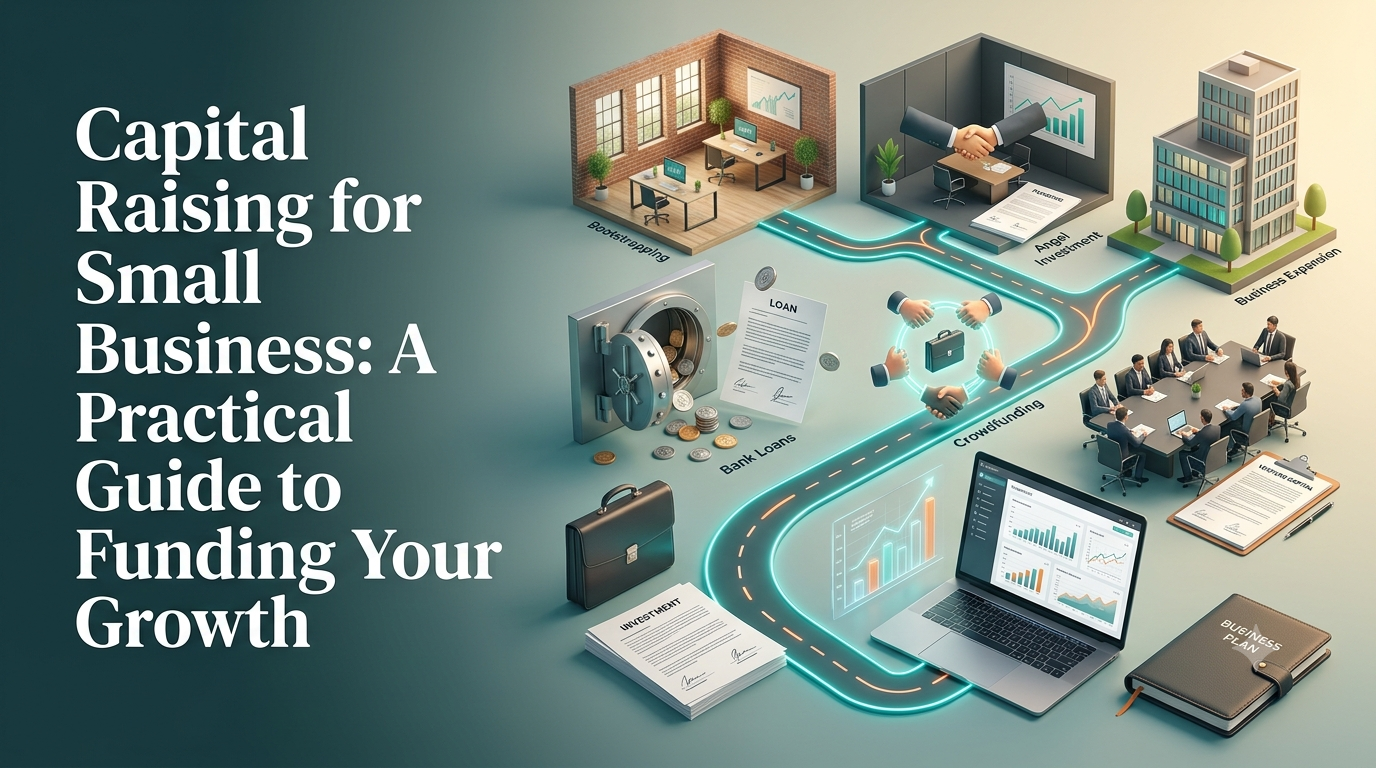
One of the biggest challenges facing small business owners is not coming up with a great idea or a solid operational plan — it’s finding the capital needed to bring that plan to life and keep it running through growth phases, slow seasons, and unexpected setbacks. Capital raising for small businesses looks quite different from the strategies used by large corporations, since small businesses typically have limited track records, fewer assets to offer as collateral, and less access to formal capital markets.
This guide walks through the most practical and commonly used methods small business owners can use to raise capital, along with the advantages, drawbacks, and considerations for each approach.
Why Capital Raising Is Different for Small Businesses
Large, established companies often have access to public capital markets, can issue bonds, negotiate favorable loan terms based on strong credit histories, and attract institutional investors. Small businesses, particularly startups or newer ventures, generally lack this track record, making traditional financing routes harder to access.
As a result, small business owners often need to get creative, combining multiple funding sources, starting small, and gradually building credibility that opens doors to larger and more favorable financing options over time.
Common Sources of Capital for Small Businesses
1. Personal Savings and Bootstrapping
Many small business owners start by funding their venture using personal savings, a strategy commonly known as bootstrapping. This approach allows founders to retain full ownership and control since there are no external investors or lenders involved.
Advantages: No dilution of ownership, no repayment obligations, complete decision-making control.
Drawbacks: Limited by the founder’s personal financial capacity, and puts personal savings at risk if the business does not succeed.
2. Friends and Family Funding
Borrowing or raising small amounts of capital from friends and family is a common early-stage funding source, particularly before a business has enough of a track record to attract formal investors or lenders.
Advantages: Often comes with more flexible terms and lower expectations for immediate returns compared to formal investors.
Drawbacks: Mixing personal relationships with business finances can create tension, especially if the business struggles or fails to generate expected returns.
3. Small Business Loans
Traditional bank loans remain one of the most common ways small businesses raise capital, particularly for established businesses with some operating history and collateral to offer.
Advantages: Does not require giving up ownership or control; interest payments are often tax-deductible.
Drawbacks: Requires regular repayment regardless of business performance; often requires collateral or a personal guarantee; newer businesses without established credit histories may struggle to qualify or may face higher interest rates.
4. Government-Backed Loan Programs
Many governments offer loan programs specifically designed to support small businesses, often with more favorable terms than conventional bank loans, such as lower interest rates, longer repayment periods, or reduced collateral requirements.
Advantages: More accessible terms compared to conventional loans, and sometimes includes additional business support services.
Drawbacks: Often involves lengthy application processes, strict eligibility criteria, and detailed documentation requirements.
5. Business Lines of Credit
A line of credit provides a flexible borrowing option where a business can draw funds as needed, up to an approved limit, rather than receiving a lump sum all at once. Interest is typically only charged on the amount actually drawn.
Advantages: Offers flexibility for managing cash flow fluctuations and unexpected expenses without committing to a large fixed loan.
Drawbacks: May come with variable interest rates and typically requires a solid credit history to qualify for favorable terms.
6. Angel Investors
Angel investors are typically wealthy individuals who provide capital to early-stage businesses in exchange for equity ownership. Beyond just funding, many angel investors also bring valuable industry experience, mentorship, and networking connections.
Advantages: No repayment obligation; access to investor expertise and connections; can provide validation that attracts further investment.
Drawbacks: Requires giving up a portion of ownership and potentially some control; finding the right angel investor can be time-consuming.
7. Venture Capital
Venture capital firms invest in high-growth-potential businesses in exchange for equity, typically targeting companies with scalable business models capable of delivering substantial returns.
Advantages: Can provide significant funding amounts along with strategic guidance and industry connections.
Drawbacks: Venture capital firms typically seek significant ownership stakes and may expect a high degree of involvement in strategic decisions; this option is generally more suited to high-growth, scalable businesses rather than traditional small businesses.
8. Crowdfunding
Crowdfunding platforms allow businesses to raise small amounts of capital from a large number of individuals, often in exchange for early access to products, rewards, or in some cases, small equity stakes.
Advantages: Can help validate market demand for a product or service while raising capital; does not necessarily require giving up significant ownership, depending on the crowdfunding model used.
Drawbacks: Success is not guaranteed and often requires significant marketing effort to reach funding goals; some platforms charge fees on funds raised.
9. Trade Credit
Trade credit involves negotiating payment terms with suppliers that allow a business to receive goods or services now and pay for them later, effectively acting as a short-term financing tool for managing working capital.
Advantages: Helps manage cash flow without needing to seek formal external financing; strengthens supplier relationships over time.
Drawbacks: Late payments can damage supplier relationships and creditworthiness; typically only suitable for short-term working capital needs rather than larger capital investments.
10. Retained Earnings
For businesses that are already generating profit, reinvesting those earnings back into the business is one of the most straightforward ways to fund growth without seeking external capital.
Advantages: No dilution of ownership, no interest or repayment obligations, complete control over how funds are used.
Drawbacks: Limited by the actual profitability of the business, which may not generate enough surplus to fund larger growth initiatives.
Choosing the Right Capital Raising Strategy
The right approach to raising capital depends on several factors specific to each business:
- Stage of the business — early-stage businesses with limited track records often rely more heavily on personal savings, friends and family funding, or angel investment, while more established businesses can access bank loans or lines of credit more easily.
- Amount of capital needed — smaller funding needs might be met through trade credit or a line of credit, while larger growth initiatives may require angel investment, venture capital, or larger loans.
- Willingness to give up ownership — business owners who want to retain full control may prioritize debt financing or bootstrapping, while those willing to share ownership in exchange for expertise and larger funding amounts might pursue equity investors.
- Cash flow stability — businesses with predictable, stable cash flow are better positioned to take on debt financing, since they can more reliably meet fixed repayment obligations.
- Industry and growth potential — high-growth, scalable business models are more likely to attract venture capital interest, while traditional small businesses, such as local retail or service providers, may find debt financing or government-backed loans more suitable.
Preparing to Raise Capital
Regardless of which funding source a small business pursues, certain preparation steps can significantly improve the chances of success:
Develop a clear business plan — a well-structured plan that outlines the business model, target market, competitive advantage, and financial projections helps build credibility with lenders and investors alike.
Maintain organized financial records — clean, accurate financial statements make it easier for lenders and investors to assess the business’s financial health and repayment or return potential.
Understand your funding needs precisely — knowing exactly how much capital is needed and how it will be used helps in choosing the most appropriate funding source and strengthens the pitch to potential lenders or investors.
Build a strong credit profile — for debt financing options, maintaining a good personal and business credit history significantly improves access to favorable loan terms.
Network within your industry — building relationships with potential investors, mentors, and industry contacts well before you need funding can make the eventual capital raising process smoother and more successful.
Common Mistakes to Avoid
- Raising too little capital — underestimating funding needs can leave a business short on resources at a critical growth stage, forcing a scramble for additional funding under less favorable terms.
- Raising too much capital too early — taking on excessive debt or giving up too much equity before it’s truly needed can create unnecessary financial pressure or dilution.
- Ignoring the cost of capital — failing to fully understand the true cost of a financing option, including interest rates, fees, or the long-term value of equity given up, can lead to poor financial decisions.
- Neglecting to plan for repayment or investor expectations — taking on debt or equity investment without a clear plan for how it will generate returns can create significant strain later on.
Building a Capital Raising Timeline
One often overlooked aspect of capital raising is timing. Many small business owners make the mistake of seeking funding only when they are in urgent need of cash, which puts them in a weaker negotiating position and limits their options.
A more strategic approach involves building a capital raising timeline well in advance of when funds are actually needed:
Six to twelve months before funding is needed — begin researching potential funding sources, understanding eligibility requirements, and building relationships with potential lenders, investors, or mentors within the industry.
Three to six months before funding is needed — finalize financial statements, business plans, and any required documentation, while beginning formal conversations or applications with selected funding sources.
One to three months before funding is needed — finalize negotiations, complete due diligence processes, and ensure all legal and administrative requirements are in place to receive funds smoothly.
Approaching capital raising with this kind of runway allows business owners to negotiate from a position of strength, compare multiple funding options, and avoid rushed decisions driven purely by urgent cash flow needs.
The Role of Business Credit History
For small businesses pursuing debt financing options, building a strong business credit history separate from personal credit can significantly expand access to favorable financing terms over time.
Establishing business credit typically involves opening accounts in the company’s name, maintaining consistent and timely payment histories with suppliers and lenders, and, where possible, separating personal and business finances early in the company’s life. A strong, established business credit profile not only improves access to loans and lines of credit but can also lead to better terms, such as lower interest rates or higher borrowing limits, as the business grows and its credit history lengthens.
Alternative and Emerging Capital Raising Methods
Beyond the traditional sources discussed earlier, small businesses today have access to a growing range of alternative financing options:
Revenue-Based Financing — this involves receiving upfront capital in exchange for a percentage of future revenue until a predetermined repayment amount is reached, offering flexibility since repayment scales with actual business performance rather than requiring fixed monthly payments regardless of revenue fluctuations.
Invoice Financing — businesses with outstanding customer invoices can sometimes access immediate capital by selling those invoices at a discount to a financing company, which then collects payment directly from the customer, providing quick access to cash tied up in accounts receivable.
Peer-to-Peer Lending — online platforms connecting small businesses directly with individual lenders can sometimes offer more flexible terms or faster approval processes compared to traditional bank loans.
Microfinance Institutions — particularly relevant for very small businesses or those in developing markets, microfinance institutions specialize in providing smaller loan amounts with more accessible eligibility requirements compared to traditional banks.
Balancing Multiple Funding Sources
Many successful small businesses do not rely on a single funding source throughout their growth journey. Instead, they strategically combine multiple sources at different stages:
- Early-stage funding might come primarily from personal savings and friends and family contributions.
- As the business establishes a track record, a small business loan or line of credit might supplement cash flow for operational needs.
- Significant growth opportunities might be funded through a combination of retained earnings, additional debt financing, and potentially bringing in an angel investor for larger strategic initiatives.
This layered approach allows business owners to match the right type of capital to the right purpose, avoiding over-reliance on any single source while managing overall financial risk more effectively across different stages of the business lifecycle.
Final Thoughts on Sustainable Growth
Ultimately, the goal of capital raising is not simply to secure funds, but to secure the right funds, on terms that support sustainable growth rather than creating long-term financial strain. A small business that raises capital thoughtfully — matching the source and structure of funding to its actual stage, cash flow patterns, and growth ambitions — puts itself in a far stronger position than one that accepts the first available offer out of urgency.
Patience, preparation, and a clear-eyed view of both short-term needs and long-term goals remain the most reliable tools any small business owner can bring to the capital raising process.
Conclusion
Raising capital is one of the most critical challenges small business owners face, and there is no single right answer for every situation. The best approach often involves a thoughtful combination of funding sources tailored to the business’s stage, industry, cash flow stability, and the owner’s willingness to share ownership or take on debt obligations.
By understanding the full range of available options — from bootstrapping and friends and family funding to bank loans, angel investment, and crowdfunding — small business owners can make more informed decisions about how to fund their growth sustainably. Careful preparation, a clear understanding of funding needs, and a realistic assessment of repayment or ownership trade-offs can significantly improve the chances of successfully raising the capital needed to build a thriving, resilient business.